
Do Olympians Pay Taxes on Medals?
Do Olympians Pay Taxes on Medals? & Related Olympic Medal Questions

Related Olympic Medal Questions
- Do Olympians Pay Taxes on Medals?
- What Are Olympic Medals Made Of?
- Who Won the First Olympic Medal?
- What Sports Is China Winning Olympic Gold Medals In?
- What State Has the Most Olympic Medals?
- Are Olympic Medals Engraved with the Winner's Name?
- Who Is the Youngest Olympic Medalist?
- Do All Olympic Gold Medals Weigh the Same?
- Do Olympians Get to Keep Their Medals?
- Do Refugee Olympic Team Athletes Get Medals?
Do Olympians Pay Taxes on Medals?
Whether Olympians pay taxes on medals depends on their country of residence, with the U.S. having specific rules. Before 2016, U.S. Olympians owed federal income tax on both the medal’s estimated value (e.g., ~$500 for gold) and any cash bonuses from the government (like the U.S. Olympic Committee’s $37,500 gold bonus). However, the Tax Cuts and Jobs Act of 2017 changed this: now, U.S. Olympians with annual income under $1 million are fully exempt from taxes on Olympic medals and bonuses. Athletes earning over $1 million still pay taxes on these rewards. Other countries like Canada, Australia, and the UK also exempt Olympians from taxes on medal-related benefits, ensuring athletes aren’t penalized for their achievement.
What Are Olympic Medals Made Of?
Olympic medals follow strict material guidelines from the International Olympic Committee (IOC). Gold medals are not solid gold—they’re 92.5% silver with a minimum of 6 grams of gold plating (about 1.2% of the medal’s total weight). Silver medals are 92.5% pure silver, matching the base of gold medals. Bronze medals are a mix of 97% copper, 2.5% zinc, and 0.5% tin. All medals must weigh at least 500 grams. Host cities often add cultural touches: the 2020 Tokyo Olympics used recycled electronics (like old phones) to make medals, while the 2018 PyeongChang Games incorporated traditional Korean metal patterns into the medal design.
Who Won the First Olympic Medal?
The first medal of the modern Olympic Games (1896 Athens) was awarded to James B. Connolly, an American athlete, for winning the triple jump. Importantly, the 1896 Games didn’t use the now-standard gold-silver-bronze system—winners received a silver medal, an olive wreath, and a diploma; runners-up got a bronze medal and laurel wreath. Connolly, a 27-year-old Harvard student who dropped out to compete, jumped 13.71 meters (45 feet) to claim first place, making him the first modern Olympic champion. He also won a silver medal in the high jump and a bronze medal in the long jump at the same Games. Gold medals were first introduced at the 1904 St. Louis Olympics.
What Sports Is China Winning Olympic Gold Medals In?
China is a dominant power in several Olympic sports, consistently topping podiums in events where it has invested heavily in training and development: 1. Diving: Known as the "Diving Dream Team," China has won more Olympic diving golds than any country (e.g., 7 of 8 golds at the 2020 Tokyo Olympics). 2. Table tennis: China has dominated since the 1980s, often sweeping all 4 gold medals (men’s singles/doubles, women’s singles/doubles) at a single Games. 3. Gymnastics: Both men’s and women’s teams excel—China has won gold in team, all-around, and apparatus events (e.g., balance beam, parallel bars). 4. Weightlifting: Chinese weightlifters set frequent world records, especially in women’s categories (e.g., 7 golds at the 2008 Beijing Olympics). 5. Shooting: China often wins the first gold of the Games in shooting events like the 10m air rifle.
What State Has the Most Olympic Medals?
As of 2024, California has the most Olympic medals of any U.S. state, with over 1,200 total medals (gold, silver, bronze) won by its athletes. This dominance stems from three key factors: California’s large population (over 39 million, providing a bigger talent pool), mild year-round weather (ideal for training in outdoor sports like swimming, track and field, and surfing), and world-class training facilities (e.g., the U.S. Olympic Training Center in Chula Vista). Key sports contributing to California’s medal count include swimming (athletes like Katie Ledecky and Michael Phelps, who trained in California), track and field, gymnastics, and beach volleyball. Florida ranks second with over 700 medals, followed by New York and Texas.
Are Olympic Medals Engraved with the Winner's Name?
Yes, Olympic medals are engraved with the winner’s name, sport, and event—but this happens after the medal ceremony. During the podium ceremony (usually within hours of the event), athletes receive a blank medal; the engraving process takes place later in a dedicated area at the Olympic Village. This ensures athletes get their personalized medals within 24-48 hours of winning. The tradition of engraving names began at the 1984 Los Angeles Olympics—before that, medals only had generic designs. Engravings are done carefully to avoid damaging the medal’s design, and athletes can often request small adjustments (like preferred name spelling) if needed.
Who Is the Youngest Olympic Medalist?
The youngest Olympic medalist in history is Dimitrios Loundras of Greece, who won a bronze medal in gymnastics at the 1896 Athens Olympics. He was only 10 years and 218 days old at the time, competing in the team parallel bars event. This record remains unbroken because modern Olympic rules set minimum age limits: most sports require athletes to be at least 16, with exceptions (like gymnastics, where athletes can be 15). Loundras’ achievement is even more notable because he competed in the first modern Olympic Games, and his young age was a product of the era’s more relaxed eligibility rules for medal competition.
Do All Olympic Gold Medals Weigh the Same?
No, Olympic gold medals do not all weigh the same—their weight varies slightly between Games, though they all meet the IOC’s minimum requirement of 500 grams. Host organizing committees can adjust the weight to fit their design or cultural elements. For example: 1. 2020 Tokyo Olympics: Gold medals weighed 556 grams (the heaviest in recent history). 2. 2016 Rio Olympics: 500 grams (exactly the minimum). 3. 2012 London Olympics: 400 grams. 4. 2008 Beijing Olympics: 244 grams. This variation doesn’t affect the medal’s status—all gold medals still have the required 6 grams of gold plating and 92.5% silver base. The weight difference is usually due to thicker metal or added design details (like the Tokyo medals’ recycled material structure).
Do Olympians Get to Keep Their Medals?
Yes, Olympians get to keep their medals permanently—they are the athlete’s personal property, awarded to recognize their achievement. The only time medals are revoked is if an athlete is found guilty of doping, cheating, or violating Olympic rules. For example, Marion Jones (track and field) had her 2000 Sydney Olympics medals stripped after admitting to using performance-enhancing drugs. In most cases, though, medals become cherished keepsakes: many athletes display them in their homes, donate them to museums (like Michael Phelps’ medals at the U.S. Olympic & Paralympic Museum), or pass them down to family members. Some athletes have sold their medals later in life (usually for charity or financial reasons), but this is rare and entirely their choice.
Do Refugee Olympic Team Athletes Get Medals?
Yes, athletes from the Refugee Olympic Team (ROT) are eligible to win Olympic medals just like athletes from national teams. The ROT was established by the IOC in 2016 to represent athletes who have fled their home countries due to conflict, persecution, or natural disaster (e.g., athletes from Syria, South Sudan, or Afghanistan). If an ROT athlete wins a medal, the Olympic flag is raised and the Olympic Hymn is played during the medal ceremony (instead of a national flag or anthem), since the team has no official country. As of 2024, the ROT has not yet won an Olympic medal, but several athletes have advanced to finals (like Yusra Mardini, a swimmer from Syria who competed in 2016 and 2020), and the team’s participation highlights the IOC’s commitment to inclusion for medal-eligible athletes.


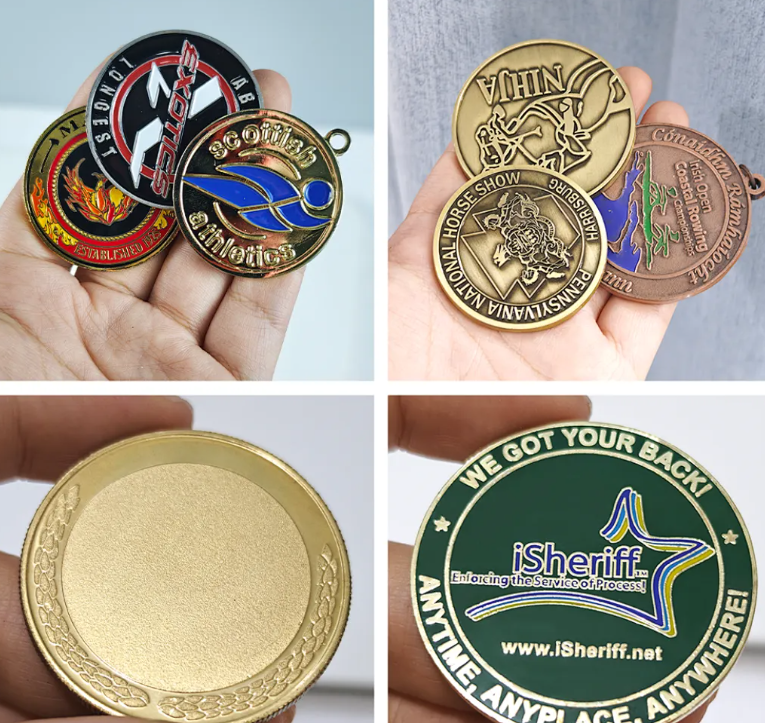
Longyi Metal Craft Products Co., Ltd, in Dongguan City, Guangdong Province focuses on the field of metal gift foreign trade. It‘s exquisite craftsmanship and efficient service have made it the prefered supplier of the world's top 500 companies.Mainly produces and customizes various medals, badges, hat pins and golf divot tool。
The factory is equipped with fully automatic casting production lines and CNC finishing equipment. The technical team independently developed 16 quality control nodes, from 3D modeling, precision casting tonano-electroplating. The original mirror polishing process makes the product gloss reach more than 98%,and the defect rate is less than 0.3%.
Support small batches of spot direct shipments, 48 hours of rapid delivery to ensure 15 days of delivery for European and American customers.24-hour online response to needs.cumulatively developed 800+ customized solutions for global customers, and the customerre purchase rate has exceeded 65% for 5 consecutive years.From pre - sale design, production, to delivery, we strictly control every detail. Your complete satisfaction is quaranteed!
What Is the Medal of Honor?
10 Medal FAQs: History, Types & Significance


For more questions please
contact us

+86 1347760487

sales15@longyimetal.com

BUILDING 1, NO. 7, YINGHE 2ND STREET, YAOSHAN, XIEGANG TOWN, DONGGUAN CITY, GUANGDONG PROVINCE